
SAP Databricks
& Snowflake
ZPARTNER supports you in adopting and operating SAP Databricks and SAP Snowflake — from strategy through go-live.
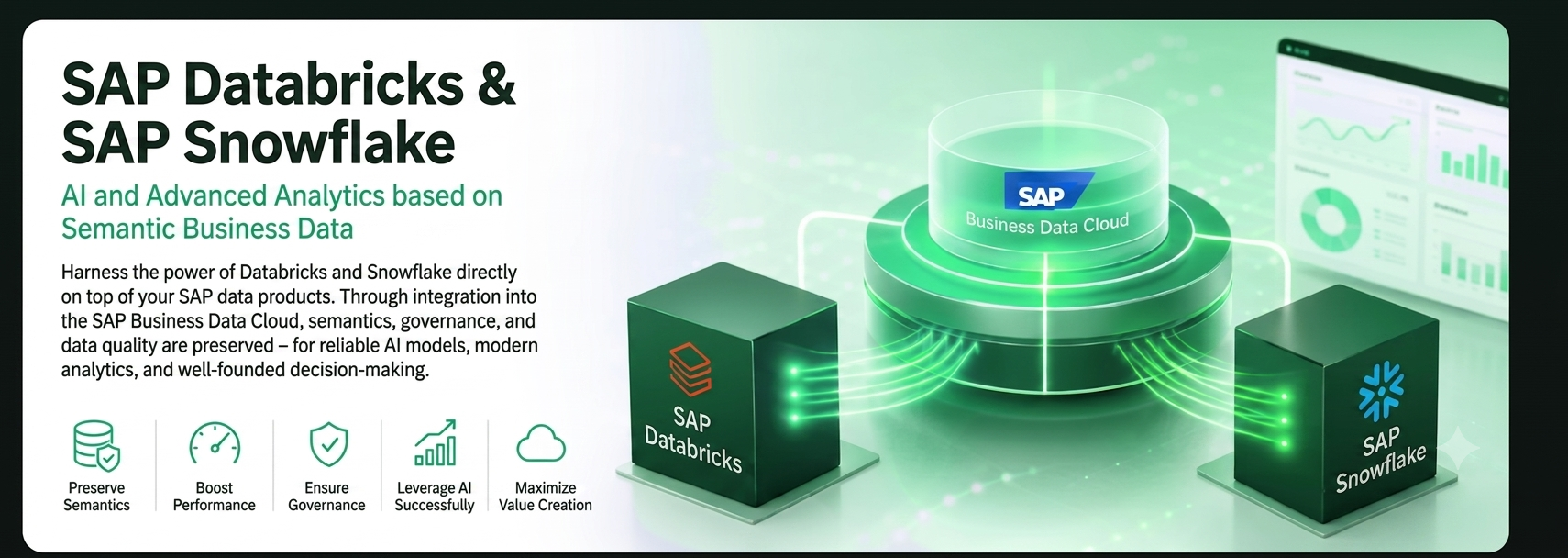
WHAT IS DATABRICKS?
The open lakehouse for SAP data
Databricks combines the best of the data warehouse and data lake in the lakehouse paradigm: ACID transactions on Delta Lake, native ML workflows with MLflow, and collaborative notebooks for data engineers and data scientists.
In the SAP context, Databricks and SAP Datasphere together enable a modern data platform — SAP data flows into the lakehouse, is enriched with ML, and becomes available for analytics and AI applications.
As an alternative, we also advise you on SAP Snowflake — depending on your system landscape and requirements, we choose the right lakehouse platform together.
FEATURES & BENEFITS
Databricks in the SAP Context
Open AI platform, deeply integrated into the SAP data landscape.
Delta Lakehouse
ACID transactions on open Delta files combine the reliability of a data warehouse with the flexibility of a data lake — scalable and cost-efficient.
ML & AutoML
MLflow for experiment tracking, AutoML for rapid model development, and feature stores for reusable ML artifacts — all on one platform.
SAP Datasphere Integration
Native connection between Databricks and SAP Datasphere: enrich SAP data in the lakehouse and bring it back into the semantic layer as a data product.
Unity Catalog
Central data management, lineage tracking, and access control across all Databricks workspaces — one governance layer for the entire lakehouse.
Data Engineering at Scale
Apache Spark, Delta Live Tables, and SQL Warehouses for large data volumes — from raw data processing to the analytical data product.
PB
Scaling
Petabyte-scale platform
1
Lakehouse
DWH + Data Lake + ML
MLflow
Experiment Tracking
Reproducible & versioned
100%
Open-source foundation
No vendor lock-in
Databricks + SAP — Your Advantage?
ZPARTNER combines SAP expertise with Databricks know-how and builds a modern, AI-ready data platform with you — from architecture to the first productive ML model.