Bulgaria is Switching to the Euro – What this Means for SAP BW
Introduction
Bulgaria will officially adopt the euro on January 1, 2026, a fixed conversion rate at 1 EUR = 1.9558 BGN will apply. That sounds simple, but in SAP BW it affects master data, key figures, currency translation logic, historical reporting, planning, and data loads from your ERP, e.g. S/4. If you have Bulgarian entities or consolidate Bulgarian figures centrally, now is the time to decide how BW should store and translate currencies before and after Go-Live.
Key BW Design Question: Store in BGN, Euro, or Both?
In BW, the right solution depends on what your business needs for reporting and auditability. Practically, you have different main approaches:
1. Keep Storing BGN, Translate to Euro at Query Runtime
Idea: No change to InfoProviders; you keep BGN as currency in your persistent layers. Queries translate to Euro using currency translation.
When this fits:
- You want a maximum historical purity (data stays as originally booked).
- You already use query-time translation for group currency.
- You don’t need Euro-native planning key figures or planning reference data.
How to implement:
- Maintain TCURR / TCURF / TCURX correctly and ensure the fixed rate exists.
- Use a currency translation type in queries (e.g., current rate, fixed rate, or time-dependent rate).
- For postings after 01.01.2026, your source systems will likely send Euro and BW becomes multi-currency in the persistent layers
Pros
Cons
2. Convert & Store Euro in BW (Physical Conversion)
Idea: You convert BGN key figures into Euro during loading or in a one-time migration, so Euro becomes the stored currency.
When this fits:
- Business wants one single reporting currency for Bulgaria after 2026.
- You do planning/forecasting in BW and want Euro-based key figures.
How to implement:
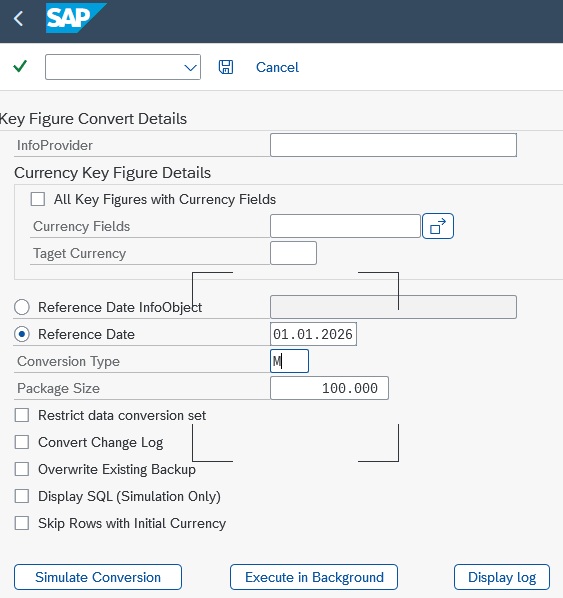
- Convert the impacted InfoProviders (SAP Note 3220814 – Currency conversion tool for ADSOs and HANA optimized cubes might be helpful including the patches already deliverd by SAP).
- In transformations or DTPs, run currency conversion using the fixed rate.
- Optionally run a historical conversion to repopulate old periods in EUR.
- Or if possible, do a full reload from ERP if the ERP project is live (might be differ depending on source of data, but mainly your source will be ERP)
Pros
Cons
3. Dual Storage: Keep BGN and Add Euro as a Second Key Figure
Idea: Store both currencies in BW; BGN for original values, Euro for standardized reporting.
When this fits:
- You need audit-proof traceability
- You want to compare pre and post 2026 data seamlessly
How to implement:
- Add EUR key figures in the same Provider (or a side-car ADSO).
- Convert during load with the fixed rate.
- Queries expose Euro as default, with BGN available (hidden default)
Pros
Cons
Conversion Rate Handling in BW: Fixed vs. Time-Dependent
Even though the conversion rate is fixed legally (1.9558), BW still needs a rule to apply it correctly. Fixed Rate Translation would mean you Maintain a fixed rate type for BGN-Euro until 31.12.9999. Time-Dependent Translation (until cutover) would mean you maintain for 2025 and earlier, different rates. This might be interesting for global reporting requirements at average rates and management reporting.
Recommendation in this case would be to create two translation types:
- Market/average rate for historical/management views.
- BGN Euro fixed rate for legal and post-cutover views.
Planning in BW-IP / BPC / SAC with BPC Live and SAC Native
If planning is on the roadmap:
- Ensure planning level currencies don’t mix BGN and EUR in one key figure.
- Favor Euro stored key figures for 2026+ planning cycles.
- Keep a conversion function for legacy BGN scenarios only.
- Make sure you also take care of the topic inside SAC
Data Flow Impacts from Source Systems
After 01.01.2026, your ERP system will likely post in EUR as local currency and still hold historical BGN documents. So BW extractors may deliver old documents in BGN and new documents in Euro.
That means BW must be ready for multi-currency delta loads. This should be considered as well.
Practical Cutover Checklist for BW Teams
- Lock the legal conversion rate in currency tables.
- Define translation types (market vs fixed).
- Decide your storage approach:
- BGN-only + query translation
- Euro-only physical conversion
- Dual storage
- Adjust transformations/DTP routines if physical conversion is chosen.
- Analyze special implementations in:
- Queries
- Planning functions
- Global reporting
Talk to your business to have a common understanding what will happen on ERP and what will happen in BW.
Final Thought: Choose Simplicity
Such projects are usually a one-time action. It is important not to overcomplicate it. But, on the other hand, you also should not make shortcuts. Understanding what is happening in the source systems and the requirements from Business is key.
Quelle: https://me.sap.com/notes/3220814/EN
Author: Franz-Josef Katzdobler
Franz-Josef is a highly experienced professional in SAP Analytics Architecture, with a strong focus on planning processes and planning architectures across various industries. His expertise spans multiple SAP planning solutions, including SAC Native, S/4 Native, and BPC Live Connection, as well as future-oriented approaches with SAP Datasphere and Seamless Planning. In addition to his deep technical knowledge, he is also skilled in project management, ensuring the successful implementation of SAP solutions. Furthermore, as a systemic coach, he provides guidance and support in navigating complex business challenges, fostering strategic decision-making and organizational growth.