Three days of SAP TechEd in Berlin, October 27 to 29, and a session catalog with more than 300 entries. Instead of scrolling through it for an evening, I had Claude build my schedule. The result: a plan without overlaps, a list of backup workshops, and a skill my colleagues can use to build their own plan.
How it started
I was looking forward to TechEd until I opened the catalog. 306 sessions across ten tracks, plus keynotes, demo stations, community talks and evening events. My focus is clear: SAP Business Data Cloud, SAP Datasphere, SAP Analytics Cloud and BW modernization. But those topics are spread across the whole catalog, not just the data and analytics track.
Problem 1: The catalog is long, and it fights back
Finding the relevant sessions means reading titles and abstracts one by one. Filtering by track helps only partly. A session on BW modernization sits in the data track, but a session on AI-enhanced analytics with Business Data Cloud sits in the Joule track. A Snowflake partner talk about SAC and Datasphere is filed under transformation.
Once you have a shortlist, the real puzzle starts:
- Many sessions run twice, on different days and in different rooms.
- Others run only once, and those are usually the ones that collide.
- Theater talks last 25 minutes, deep dives 45, and hands-on workshops 2 hours, so the slots never line up.
- Rooms are spread across the venue, so back-to-back sessions need walking time.
Which repeat do you pick so that a one-time session is not lost? Doing that by hand for three days is tedious and easy to get wrong.
Problem 2: Only two hands-on workshops can be reserved
Hands-on workshops are the most valuable part of TechEd for me. But with a full conference pass you can reserve only two of them in advance. Favoriting a workshop is not enough: it has to go into your schedule with „Add to schedule“. Every other session is first come, first served.
That does not mean the other workshops are closed. If seats are still free, you can often just walk in. For that to work, you need to know which other workshops are interesting, when they run and what you would give up for them. Otherwise you are standing in the hallway with a free hour and no idea where to go.
So a good plan needs two layers: the sessions you will definitely attend, and a backup list of workshops you would switch to if a seat opens up.
The idea: let Claude read the catalog
My request was one sentence: here is the catalog link, build me a realistic schedule for all three days with sessions on Datasphere, Business Data Cloud, SAP Analytics Cloud and related topics, without overlaps.
What happened next:
- Claude opened the catalog in its browser and loaded all sessions, including times, rooms, tracks, products and abstracts.
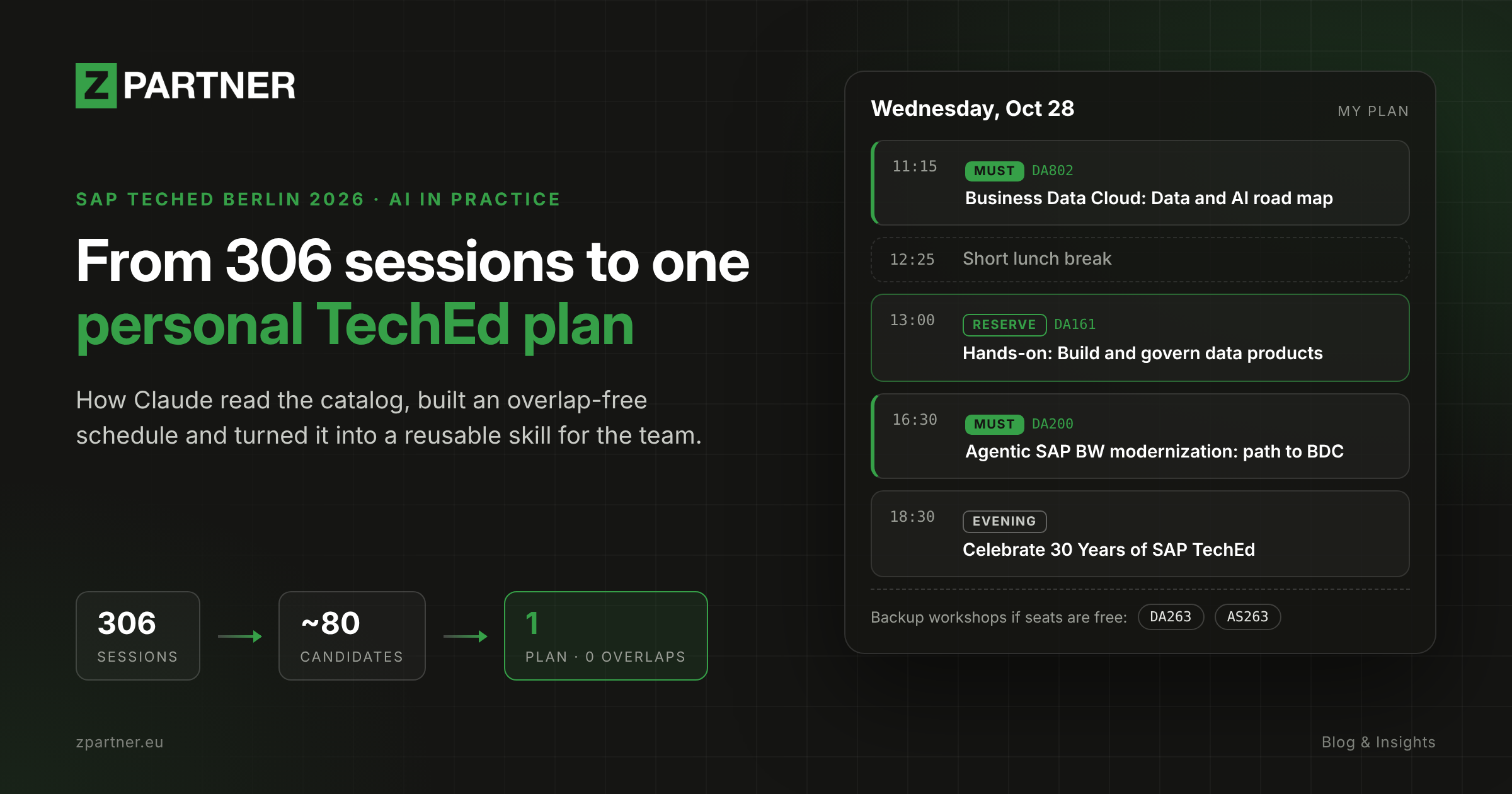
- It filtered them by product tags and keywords, not just by track. That left about 80 candidates out of 306.
- It built a plan with no overlaps, real lunch breaks, and repeats placed so that one-time sessions were not lost.
- It marked the trade-offs it made, for example where a session runs in parallel to something more important.
Then we refined the plan in a short conversation. I asked whether there was more than roadmaps, and got a list of deep dives and workshops with what each would replace. I asked which of two colliding workshops was more interesting for me, and got a reasoned recommendation: calculation views in Business Data Cloud over agentic planning, because it fits BW migration work better.
What the plan looks like
The result is a web page with one block per day, which I also exported as a three-page PDF. Every slot shows time, room, session code, a one-line reason and, where it makes sense, an alternative in the same slot.
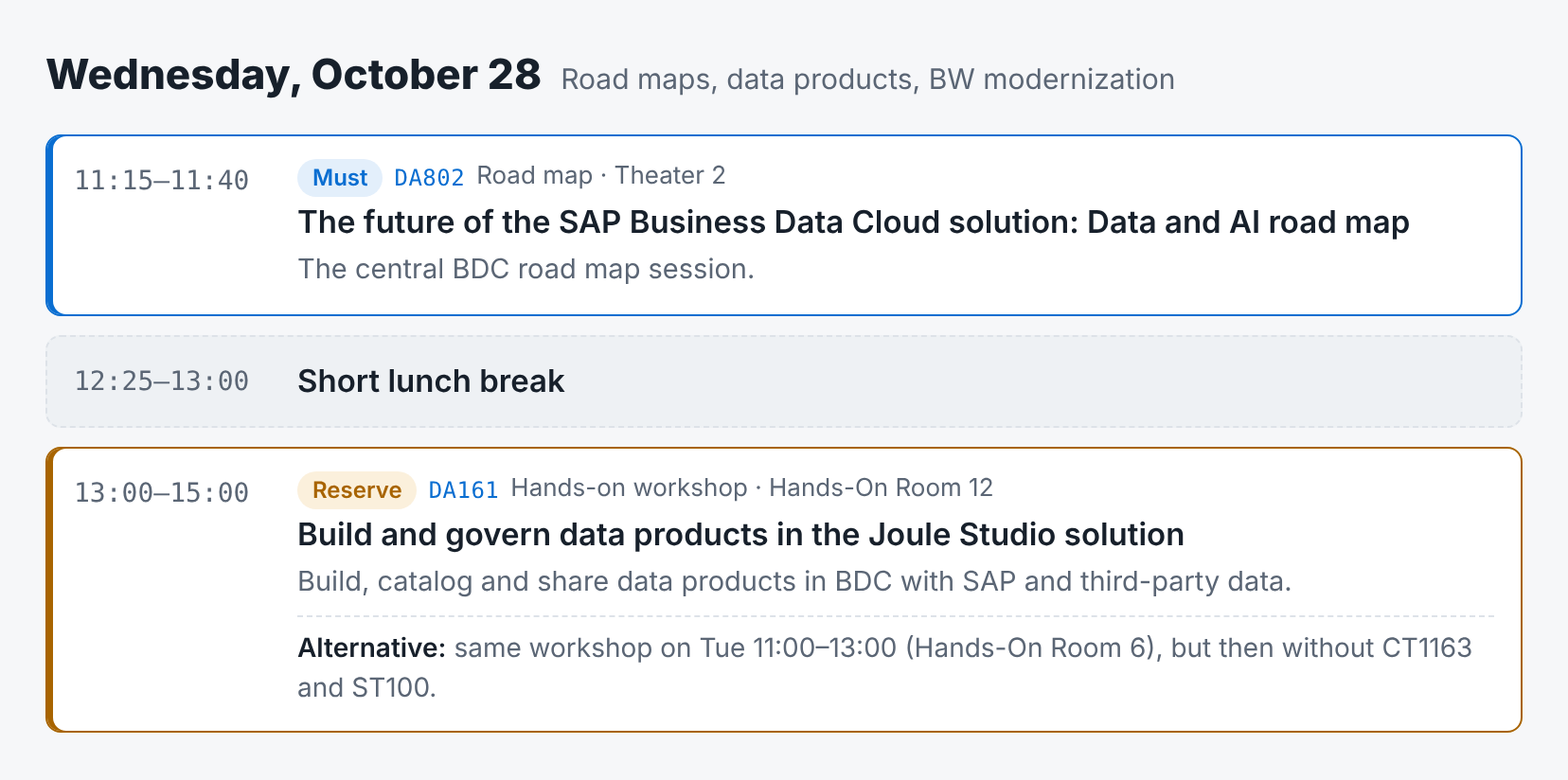
| Label | Meaning | Example from my plan |
|---|---|---|
| Must | Core topic, often offered only once | DA200 Agentic SAP BW modernization: your path to SAP Business Data Cloud |
| Reserve | One of the two hands-on workshops to book in advance | DA161 Build and govern data products, DA264 Calculation views in SAP Business Data Cloud |
| Optional | Nice to have if there is energy left | Partner talks and the developer keynote |
| Evening | Evening events at the end of each day | Networking reception on Tuesday, the 30-years-of-TechEd party on Wednesday |
Next to each day there is a second column with the other interesting hands-on workshops of that day. Each entry shows time and room, a one-line summary, and which planned sessions I would give up to attend it. That is my backup list for free seats.
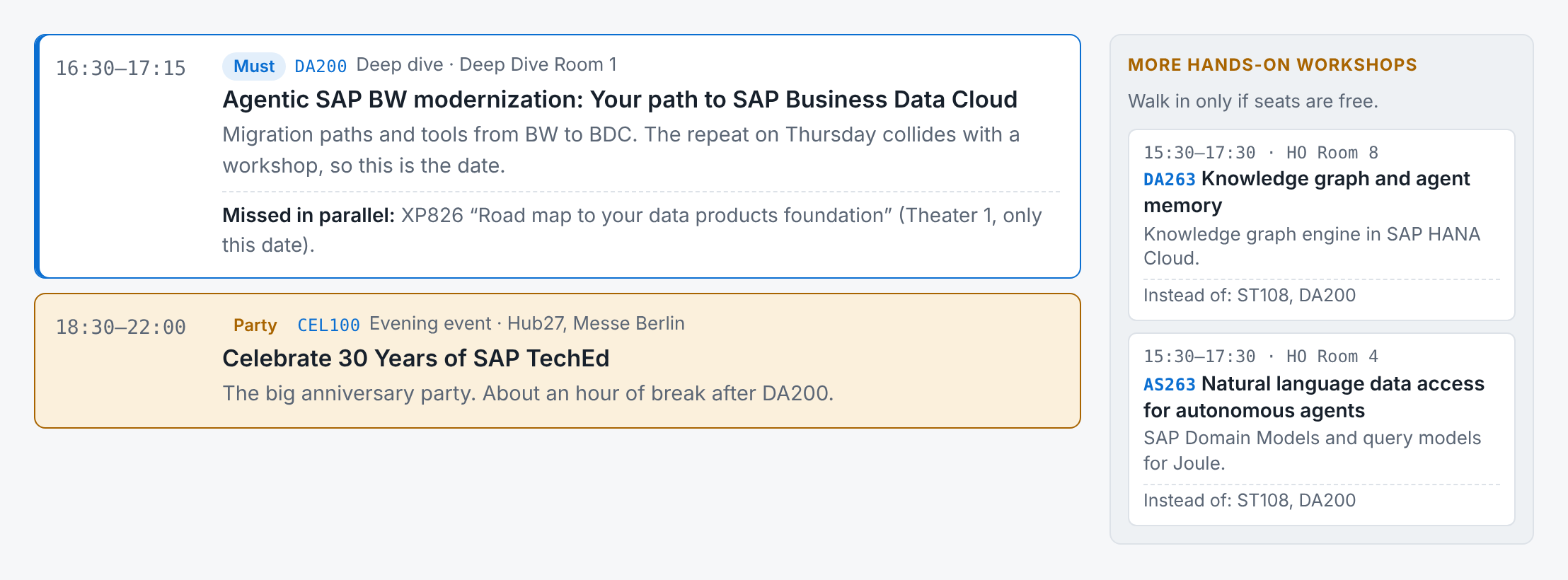
The plan also covers the details that are easy to forget: zero-minute room changes are flagged, repeated sessions are listed, and everything after my departure on Thursday is left out.
From my plan to a skill for colleagues
Several colleagues are going to TechEd too, each with different topics: integration, ABAP and clean core, AI and Joule. So I asked Claude to turn the whole process into a skill, a reusable set of instructions that Claude follows whenever someone asks for a TechEd schedule.
The skill works in four steps:
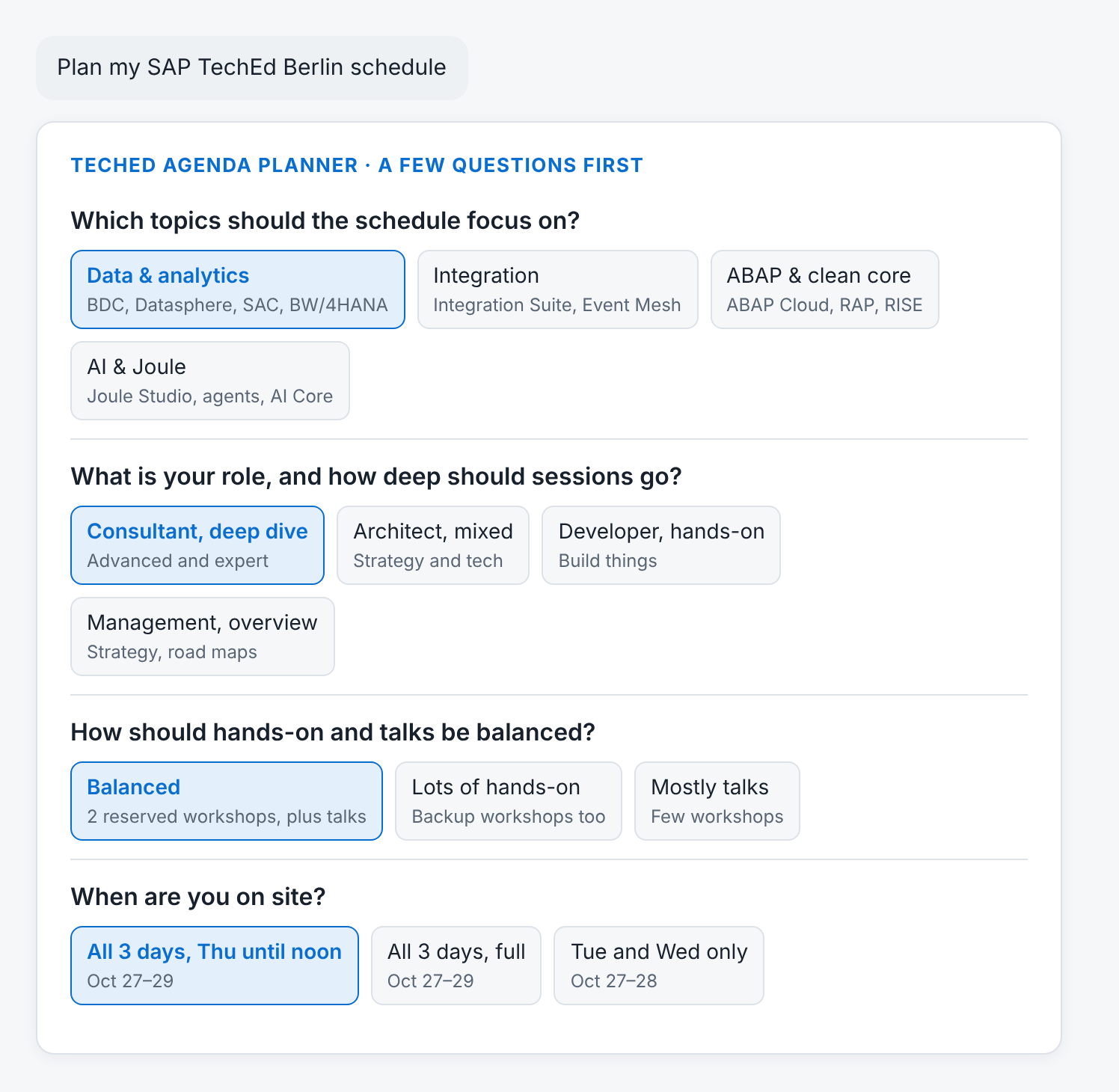
- It asks about topics, role, preferred depth, the balance of hands-on and talks, and travel days.
- It loads the full session catalog.
- It builds the plan with the same rules as mine: no overlaps, breaks, two reserved workshops, alternatives, backup workshops and evening events.
- It publishes the plan as a page and, on request, as a PDF.
The instructions also say where to find new catalog access details if SAP changes them, so the skill can be reused for other TechEd locations.
Takeaways for your own conference planning
The biggest win was not the time saved on reading. It was a plan I trust, with the trade-offs written down instead of buried in my head. A few tips if you try this yourself:
- Name your topics as products, not tracks. Relevant sessions are spread across the catalog.
- Decide on your two reserved workshops first, then build the rest around them.
- Keep a backup list of workshops with free seats in mind, and know what you would give up for each.
- Check repeats before you drop a session. Often the second date fits.
- Verify the plan against the official catalog shortly before the event. Rooms and times can still change.
See you in Berlin.