Intro
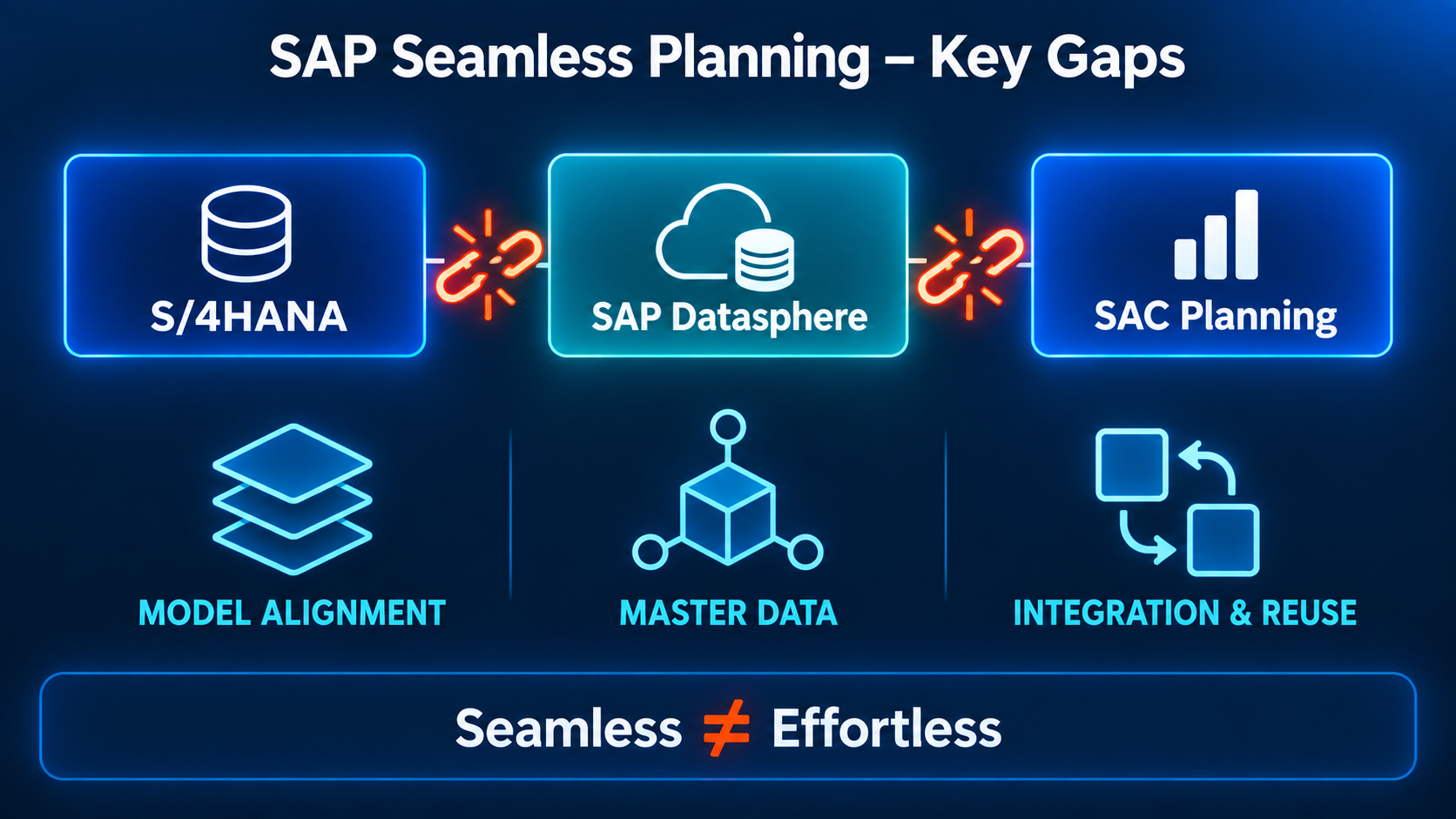
S/4HANA, Datasphere, and SAP Analytics Cloud (SAC) are the core components of the Business Data Cloud vision within the SAP Analytics stack. For years, many customers built their planning solutions on BW-IP. That layer is now being replaced: SAC Planning, and specifically SAC Seamless Planning, is positioned as the new planning layer for this architecture.
On paper, this sounds like a clean, integrated story — reference data flows from S/4HANA through Datasphere, planning happens natively in SAC, and everything speaks the same semantic language. In practice, teams running real implementations hit a number of gaps that are worth calling out before starting a new planning project on this stack. This post walks through those challenges.
Datasphere and Its Role
In this architecture, Datasphere is the data warehouse layer: you extract data from an S/4 system and model it as reference data. With Seamless Planning, the planning model and its dimensions — created in SAC — are now deployed into Datasphere as well, rather than living purely inside SAC.
With the live version of a planning model, reference data modeled through a fact view in Datasphere can be linked directly to the planning model. That part works reasonably well.
Master data integration is a different story. It is not seamless yet. Today, master data has to be synchronized separately via the OData interface, which breaks the effortless, single-pipeline integration that the “Seamless Planning” name implies. You end up maintaining a parallel master data sync path alongside your reference data modeling — one interface per dimension, in many cases — rather than one consistent flow from S/4 through Datasphere into SAC.
Challenges
Based on hands-on implementation work, the recurring pain points fall into a few buckets:
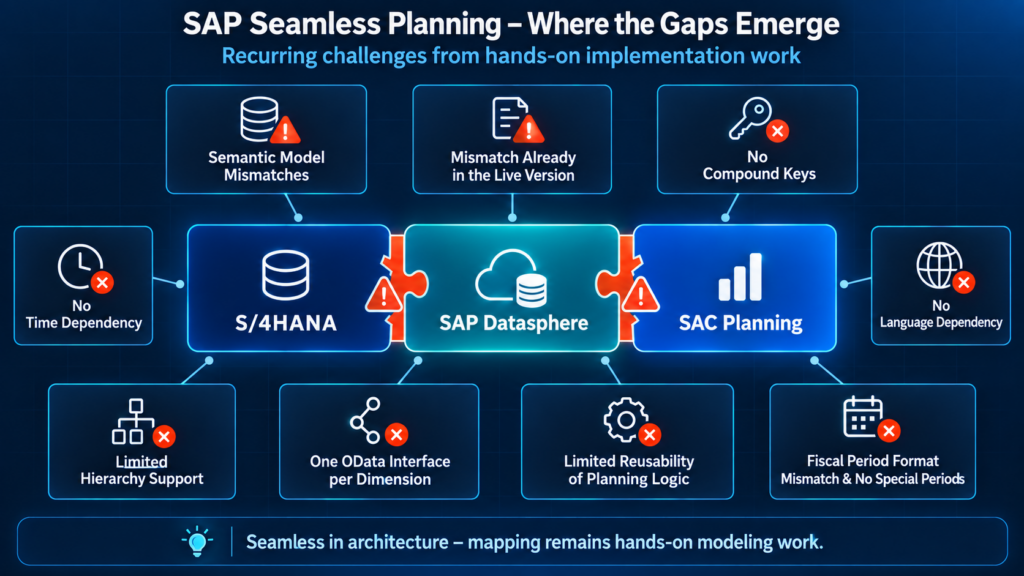
- Semantic mismatch between S/4, Datasphere, and SAC. The three layers don’t share one uniform data model, so mapping between them is not a given — it’s ongoing modeling work.
- The mismatch shows up as early as the live version. Even with a live version connecting reference data to the planning model, the challenge is already there: master data is modeled differently on the SAC planning side than on the Datasphere/S/4 side. This isn’t a downstream integration problem you hit later — it’s baked in from the first connection you make.
- Compounding is not supported. Compound key structures common in S/4 master data (and in Datasphere models built on top of it) don’t carry over cleanly into SAC dimensions.
- Time dependency is not supported. Time-dependent master data — a standard pattern in S/4 and BW — has no native equivalent in the SAC planning model.
- Language dependency is not supported. Multi-language texts on master data, again a standard S/4/BW capability, are not handled natively.
- Limited hierarchy support. Hierarchies that work fine in Datasphere or S/4 often can’t be represented, or can only be partially represented, once they reach SAC. Even with newer Seamless Planning capabilities, hierarchies built in an SAC model aren’t automatically created on the Datasphere side — they still need to be rebuilt manually.
- Interface complexity between SAC and Datasphere. Dimensions are currently loaded into SAC via the OData interface, and in practice this means building and maintaining one interface per dimension rather than a single consolidated integration.
- Reusability of planning logic. Because the underlying data models differ across layers, planning logic built for one context doesn’t transfer cleanly to another — it often has to be rebuilt or adapted per model.
- Fiscal period format mismatch. Datasphere and S/4 represent the fiscal period as a 7-character value, while SAC uses a 6-character format. On top of that, SAC has no concept of special periods, which S/4 and BW rely on for year-end adjustment postings — another gap that has to be handled explicitly in the mapping.
The “why” behind several of these gaps isn’t always obvious from the documentation, which is itself part of the challenge: teams end up reverse-engineering constraints during implementation rather than planning around them up front.
On the roadmap side, dimension reuse is planned to address the master data gap. That’s a welcome step, but it’s not yet clear that reusing dimensions actually resolves the underlying semantic mismatch between the SAC and S/4/Datasphere data models — it may reduce interface count without closing the modeling gap itself. Worth watching, but not something to bank on yet when scoping a project.
Takeaway
Put together, a few things become clear once you’ve run this integration end to end:
S/4 to Datasphere integration works well. Those two systems largely speak the same semantic language, and modeling reference data there is comparatively straightforward.
SAC Planning follows a different data model. Because of that, reference data and master data currently need to be modeled somewhat differently for planning purposes than they are for reporting or reference use. Bringing actuals and plan data back together later is additional work on top of that — it’s manageable, but it doesn’t happen for free just because both live under the same SAP umbrella.
Writeback to S/4 surfaces similar challenges in reverse: compounding, time dependency, and mismatches like fiscal periods need to be accounted for when data flows back into the source system.
None of this is a knock on the SAC front end itself. The planning entry experience is genuinely good and works well, and with features like asymmetric reporting, the end product looks polished from the user’s perspective. Most of the friction described here sits in the data model and integration layer underneath — not in what the planner sees on screen, and it’s worth keeping that distinction in mind when scoping a project.
Thoughts
SAC Planning, as it stands, isn’t a plug-and-play integrated solution yet — and that’s the main thing to plan around. You can absolutely build solid planning solutions on it, but expect some workarounds along the way, particularly for master data.
It’s also a moving target. SAP has been actively investing here: dimension reuse for master data is on the roadmap (and already rolling out for some scenarios), live consumption of Datasphere data without replication, cross-system orchestration, and migration tooling for existing models are all part of the direction of travel. That’s encouraging — but it’s not yet clear that dimension reuse on its own resolves the underlying semantic mismatch between the SAC planning model and the S/4/Datasphere model, so it’s worth treating as a mitigation to watch rather than a fix to plan around today. Teams scoping new planning projects on this stack should budget realistic time for the integration work rather than assuming “seamless” means zero effort.
The direction is right, and the front-end experience shows what this can look like once the underlying data model gaps close. Getting there is still very much a joint effort between SAP’s roadmap and solid architecture work on the implementation side.