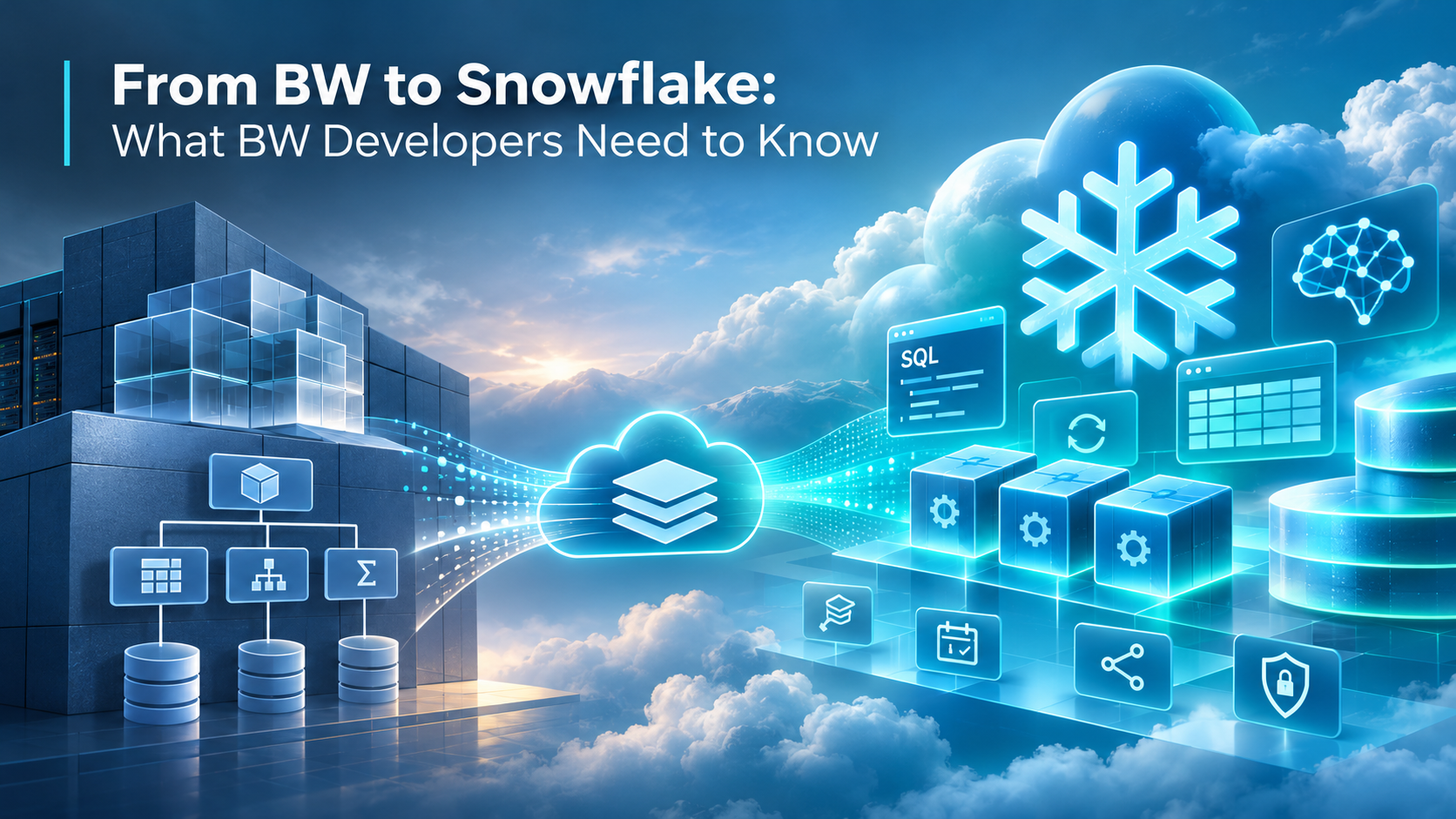
Since SAP started offering Snowflake as part of SAP Business Data Cloud, Snowflake has become a topic for every BW team. This post looks at the platform from a BW developer’s point of view. It starts with the fundamental difference between BW as an application and Snowflake as a data platform, then walks through the concepts you meet on day one of a Snowflake project, from virtual warehouses to zero-copy cloning. Next, it maps familiar BW objects such as ADSOs, InfoObjects and process chains to their Snowflake counterparts and names what you have to rebuild yourself. It then compares how ready BW and Snowflake are for AI applications, shows how SAP data reaches Snowflake through the zero-copy integration with Business Data Cloud, and closes with what all this means for BW teams.
Application vs. platform: the fundamental difference
SAP BW is an application with a built-in data model; Snowflake is a data platform with SQL as its interface. BW prescribes what a data model looks like: InfoObjects with master data, texts and hierarchies, ADSOs with activation logic, queries with key figures and variables. Snowflake only gives you databases, schemas, tables and views. You build the semantics yourself or get them from a tool on top.
Three more differences shape day-to-day work:
- Storage and compute are separate. In BW/4HANA, data and compute live in the same HANA server, sized for peak load. In Snowflake, data sits in cloud object storage (S3, Azure Blob, GCS) and processing happens in virtual warehouses that you start, resize and stop independently.
- SQL instead of a modelling GUI. What BW builds as a transformation with an ABAP routine or AMDP is SQL, Python (Snowpark) or a tool like dbt in Snowflake. Versioning runs through Git, not transport requests.
- Pay per use. Instead of a license plus hardware, you pay credits per second of running warehouse and storage per terabyte. Badly written SQL costs real money; a suspended warehouse costs nothing.
Concepts BW does not have
The following terms come up on day one of every Snowflake project. None of them has a real counterpart in BW.
Virtual warehouses
A virtual warehouse is not a data warehouse in the BW sense but a compute cluster. Sizes run like T-shirts from X-Small to 6X-Large; each step doubles both power and credit consumption. After a configurable idle time the warehouse suspends itself and resumes within seconds on the next query. The usual pattern is one warehouse per workload: one for loading, one for reporting, one for data science. A nightly load never slows down the business users‘ dashboards, a problem every BW operator knows.
Micro-partitions and pruning
Snowflake automatically stores every table in compressed, columnar blocks of 50 to 500 MB of uncompressed data, the micro-partitions. For each block it keeps the minimum and maximum value of every column. A query reads only the blocks whose value range matches the filter. There are no indexes, no partitioning by fiscal year and no aggregate design as in BW; for very large tables you set a clustering key at most.
Time Travel and Fail-safe
Every change to a table stays retrievable for a configurable period, up to 90 days depending on the edition. A SELECT … AT (TIMESTAMP => …) shows yesterday’s state, and UNDROP TABLE brings back a dropped table. What would be a request rollback or a backup restore in BW is one line of SQL here.
Zero-copy cloning
CREATE DATABASE dev CLONE prod creates a complete copy of a database in seconds without copying any data. The clone points to the same micro-partitions; storage is only charged for what changes afterwards. A development environment with real production data is no longer a system-copy project but a single command.
Streams, tasks and dynamic tables
Streams track which rows changed since they were last read, comparable to an ADSO’s change log. Tasks run SQL on a schedule or after one another and form a dependency graph. Dynamic tables go one step further: you define the result as a query plus a target freshness (target lag), and Snowflake handles the incremental refresh itself.
Secure data sharing
Data can be shared with other Snowflake accounts without copying or exporting it. The consumer sees the tables as a database of their own and queries them on their own warehouse. The integration with SAP Business Data Cloud builds on the same principle.
Snowpark
Snowpark runs Python, Java and Scala code directly in Snowflake, on the same warehouses and under the same permissions as SQL. pandas-style DataFrames, custom functions and machine learning training run next to the data instead of exporting it to a separate environment.
Role-based access control
In Snowflake every object is owned by a role, and roles inherit from each other. Privileges are granted with GRANT on database, schema, table or view. Row and column protection comes from row access policies and masking policies, which you attach to tables and which apply to every query, whatever tool sends it.
What happens to ADSOs, InfoObjects and process chains?
Almost every BW object has a counterpart in Snowflake, but rarely a one-to-one match. The table shows where a BW developer should look first.
| BW object | Snowflake counterpart | What is different |
|---|---|---|
| InfoObject (characteristic with master data, texts, hierarchies) | Dimension table, view | No built-in semantics; texts, time dependency and hierarchies are modelled by hand |
| ADSO (standard, with activation) | Table with MERGE, dynamic table | No activation queue; the upsert logic lives in SQL |
| Change log, delta process | Stream | A stream returns the changes since it was last read |
| CompositeProvider, Open ODS view | View | Joins and unions in SQL, without a separate runtime engine |
| BW query (key figures, variables, structures) | Semantic view | Covers metrics and dimensions, but not structures, exception aggregation or variables |
| Transformation, DTP | SQL, Snowpark, dbt | Code in Git instead of an object in the repository |
| ABAP (routines, AMDP, classes, function modules) | Snowflake Scripting, stored procedures and UDFs in SQL, Python, Java, Scala or JavaScript, Snowpark | No proprietary language or application server; code runs inside the database on a warehouse and is versioned in Git |
| Process chain | Task graph, dynamic tables | Dependencies in SQL, monitoring via Snowsight or Account Usage |
| Analysis authorization | Row access policy, masking policy | Applies to every access, not just queries |
| Transport request | Git plus CI/CD, zero-copy clone | Environments are databases in the same account or separate accounts |
| Near-line storage, data tiering | Not needed | Object storage is cheap; cold data stays in the same table |
What you will miss: Business Content, non-cumulative key figures, currency and unit conversion from customizing, exception aggregation. Snowflake ships none of these, and SAP data products do not bring them either: they carry tables plus CSN metadata, while currency conversion and non-cumulative measures are modelled in the Datasphere analytic model, with exchange rates from the replicated TCUR* tables (ZPARTNER on NCUM in Datasphere). If you need this logic in Snowflake, you rebuild it in SQL, or you calculate it in Datasphere, persist the result and publish it as a customer-managed data product that BDC Connect can share (SAP Learning, full learning journey).
Why Snowflake is the better foundation for AI applications
AI applications need data in one place, models next to that data, and semantics a language model can read. BW offers none of these out of the box; Snowflake has built all three into the platform.
All data in one place. Besides tables, Snowflake stores JSON in the VARIANT type and documents, PDFs and images in stages, under the same permissions as the S/4HANA figures.
Language models as SQL functions. Cortex AISQL functions such as AI_COMPLETE (GA since 21 November 2025) call models from Anthropic, Meta, Mistral, OpenAI and others inside a query, within Snowflake’s security perimeter (Snowflake, June 2025). Categorising 50,000 complaints becomes one SELECT.
Semantics for language models. Semantic views define metrics and dimensions as schema objects (Snowflake documentation), and Cortex Analyst and Cortex Agents generate SQL from them. Clean key figure definitions, a core BW skill, become the basis for natural-language questions.
Agents and open interfaces. Cortex Agents, Snowflake Intelligence (now Snowflake CoWork) and the Snowflake-managed MCP server have been GA since 4 November 2025 (Business Wire, Snowflake documentation). External agents such as Claude or Cursor use the same roles as any other access.
Python next to the data. Snowpark and notebooks train and run models, such as sales forecasts, on the same warehouses.
The catch: every model call costs credits, so set budgets and monitoring from the start.
AI readiness today: BW vs. Snowflake
BW has no AI features of its own; SAP places AI in Business Data Cloud. As of November 2026:
| Capability | SAP BW (BW/4HANA, BW PCE) | Snowflake |
|---|---|---|
| Language models in SQL | None in BW; SAP runs generative AI in BDC and the generative AI hub | Cortex AI functions, AI_COMPLETE GA since November 2025 |
| Unstructured data (documents, PDFs) | No support documented | AI_EXTRACT GA since October 2025, Document AI |
| Vector search | Not in BW; the HANA Cloud vector engine sits outside BW | VECTOR type GA since May 2024, Cortex Search GA since October 2024 |
| Natural-language questions, agents | None in BW; Joule GA in Datasphere (Q1 2026), Joule agents for BDC data in private preview | Cortex Agents and Snowflake Intelligence (CoWork) GA since November 2025 |
| Semantic layer for language models | BW queries are not addressable by LLMs; route via Data Product Generator to Datasphere | Semantic views, querying GA since August 2025, generated from SAP CSN |
| Python and ML next to the data | HANA PAL/APL in BW on HANA, predefined algorithms, no GPU | Snowpark, ML Jobs, GPU compute pools in Snowpark Container Services |
| Access for external agents (MCP) | No official SAP MCP server for BW; community servers only | Snowflake-managed MCP server GA since November 2025 |
| Vendor roadmap | Maintenance: BW/4HANA until 2040; no BW announcements at SAP TechEd 2026 | AI is the core of the product roadmap |
Sources: SAP BW modernization deck 2026, SAP Business AI highlights Q1 2026, SAP Sapphire 2026 innovation guide, SAP Learning on BW and BDC, SAP AI MCP server list, Snowflake release notes 2025, vector type GA, Cortex Search GA, semantic views GA, SPCS GPU instances, CoWork rename.
Snowflake in the SAP world: zero-copy instead of extraction
For a long time, getting SAP data into Snowflake meant extracting, replicating and losing the semantics. Since SAP and Snowflake announced their partnership at SAP TechEd on 4 November 2025, there is a direct path through SAP Business Data Cloud. A separate post will cover the setup in detail; here is the short version.
There are two variants: SAP Snowflake runs inside Business Data Cloud for customers without their own Snowflake account, and SAP BDC Connect for Snowflake links an existing account. Both use the same Zerocopy Connector, generally available since 4 May 2026 (release note).
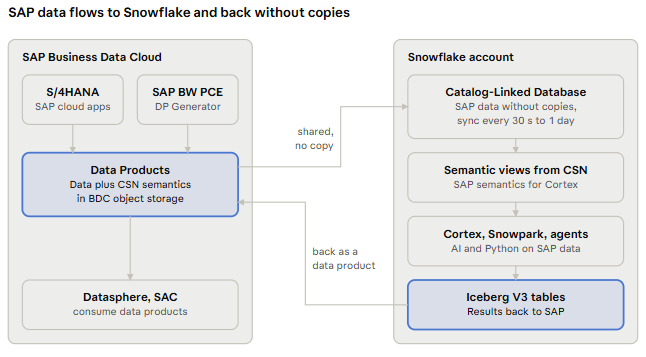
SAP data products appear in Snowflake as catalog-linked databases, without copying any data. Snowflake generates semantic views from their CSN metadata, so the SAP semantics are ready for Cortex Analyst (Snowflake documentation). Results such as forecasts flow back to Business Data Cloud as data products built on Iceberg tables.
An existing BW/4HANA does not have to be replaced for this: with SAP BW Private Cloud Edition and the Data Product Generator, BW data becomes data products in Business Data Cloud.
What this means for BW teams
Snowflake is not a new BW and does not try to be one. Anyone expecting a ready-made data model with Business Content, analysis authorizations and a query designer will be disappointed. Anyone looking for an open platform for SAP and non-SAP data, Python and language models will find it here, and since the zero-copy integration, without a break from the SAP world.
A BW team’s know-how is worth more here than it seems at first. Clean key figure definitions, master data logic and authorization concepts are missing in many Snowflake projects, and they decide whether an AI agent gives correct answers or merely plausible ones. The best way in is a concrete use case: share an SAP data product with Snowflake, put a semantic view on top and ask the first question in natural language.
Sources
- SAP and Snowflake add zero-copy sharing between their systems, CIO, 5 November 2025
- SAP Launches Snowflake Solution Extension for Business Data Cloud, SAPinsider, 6 November 2025
- SAP and Snowflake Unleash the Power of Data and Enterprise AI Across the Business Data Fabric, Business Wire, 4 November 2025
- About SAP and Snowflake, Snowflake documentation
- Explore SAP data products and Publish data to SAP BDC, Snowflake documentation
- SAP BDC Zerocopy Connector (general availability), Snowflake release notes, 4 May 2026
- Snowflake Intelligence Brings Agentic AI to the Enterprise, Business Wire, 4 November 2025
- Snowflake Introduces Cortex AISQL and SnowConvert AI, June 2025
- Semantic views and Snowflake-managed MCP server, Snowflake documentation